

The case for change
There’s a growing body of evidence that business performance accelerates when teams work together effectively. This is good news for the majority of sales teams who struggle with over-dependence on a few star performers and want to level up the rest of the team.
Data from team experts, Squadify, shows that the teams that outperform are not usually the ones with the most individual heroes. They are made of ‘good enough’ people who have a shared goal and know how to align, support each other and execute together.
In today’s B2B environment where buying journeys are longer, messier and more political than they used to be, sales is a team sport not a solo pursuit.
Increasingly, team performance is the lever that determines whether growth is repeatable and sustainable. The reality is most sales teams are not set up to operate that way. However, just a few simple changes can set the path for higher performance.
What is a high-performing team?
Let’s start with some definitions:
High-performing = ‘operating better, faster, or more efficiently than others’ (Merriam Webster).
Teams = Two or more people with a shared goal and who are dependent on each other to achieve that goal. (Squadify).
What high-performing sales teams do differently
Luckily team performance isn’t a black art. Squadify have been studying team performance for years and identified the 3 Conditions for high performing teams:
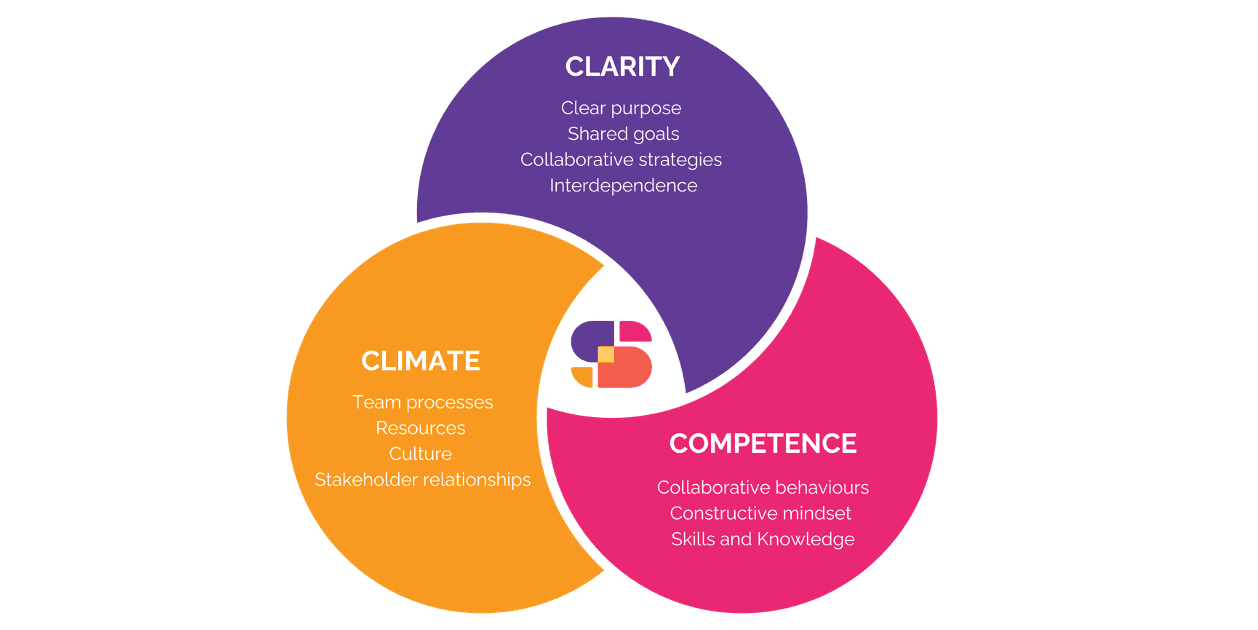
They have tons of insightful data about what makes a difference, and three factors that rise to the top are:
1. Clarity and Climate are the biggest indicators of high performance. The teams with ‘good enough’ competence and high clarity and climate have the advantage. Competent individuals who lack clarity or climate rarely achieve their combined potential.
2. When teams know how to work together to achieve the goal, performance accelerates. As Juliet Owen, Chief Data Officer at Squadify, explains: ‘This condition acts as a tipping point. Teams that lack clarity on how they actually work together rarely achieve high performance, but once that clarity is in place, performance accelerates quickly. Most teams focus on what they need to achieve; our data suggests that the real differentiator is whether they are equally clear on how they will work together to achieve it.’
3. Perception of resource sufficiency improves. Juliet again: ‘A universal complaint is not having enough resources to get the job done. Our data suggests that as teams gain clarity on their goals and how they work together, they become better at prioritising effort and attention. As a result, teams see resources as less of a constraint on performance.’
Personally, I see time and again, that when people truly come together to work on a deal, or to share learning, the wins go up and the ripple effect compounds.
The journey to sales team performance
Of course, operating as a team is not a binary thing. I’ve been thinking about what the journey to high team performance looks like specifically for a sales team. Full disclaimer, do I see sales teams that are fully optimised and scaled? Honestly, no, and there is the opportunity. I think we’re at the start of something. In a world where you need every competitive differentiator you can find, you’ve got early mover advantage hiding in plain sight.
Combining Squadify data with Alate insights and experience, here’s a working path through four levels of team performance:
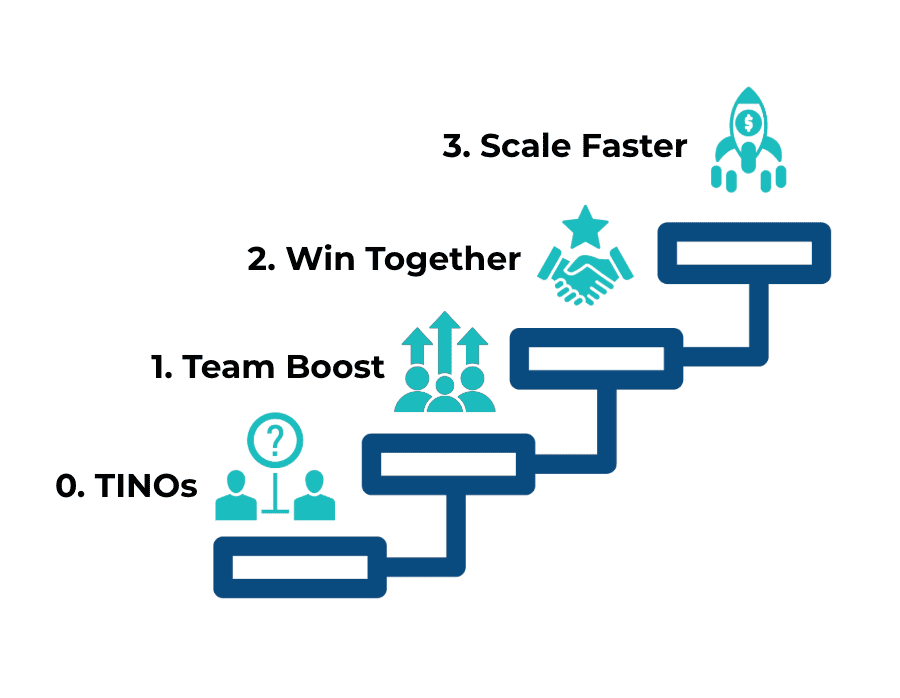

| Level | 0. TINOs | 1. Team boost | 2. Win together | 3. Scale faster |
| Key focus | ‘Team In Name Only’.
No shared goal, working independently for the same manager. |
Evolve
Individual targets but win more by proactively learning and responding to change faster together. |
Optimise
Shared accountability for achieving the overall target.
|
Scale
Operationalise team performance for scale.
|
| Ownership | Leader drives. | Leader supports. | Team drives. | System drives. |
| Team mindset | ‘My target’. | ‘Let’s learn and achieve more by working together’. | ‘We’re all accountable for the overall target’. | ‘This is how we make a difference here’. |
| What the leader does | Hub & spoke management: little team interaction without them. | Facilitates, supports and coaches.
Sets up the systems and environment. Creates psychological safety. |
Establishes team measures of success.
Supports and coaches. Steps up to more strategic leadership and execution. |
Focuses on strategic planning, execution and development. |
| Outcomes | Individual performance. | Increase sales team results. | Team drives overall results. | A system for scale:
Faster ramp up, reduced reliance on single individuals. Frees leader. |
Assess where you are and build your team performance
In this article I’ll focus on how to move from Level 0 TINO to a Level 1 team that knows how to learn and share together.
For a deeper dive on all the stages, check out the free playbook.
Level 0: TINOs
According to Dan Hammond, Chief Product Officer at Squadify, around 80% of teams that use the Squadify platform start as TINOs. I expect that’s higher for sales teams and, a sidenote for senior leaders: almost all CEO-led exec teams are TINOs.
Key focus: Personal goals / doing tasks.
How to tell if you have a TINO:
- No shared goal. Individual goals aren’t linked.
- Everything runs hub and spoke through the leader.
- Pre-sales, specialists etc drop in and out of opportunities as needed without a joined-up opportunity engagement plan.
- Trust and psychological safety are ‘accidental’. Shared learning only happens in formal situations.
Here’s how to level up:
”Speed to learning creates speed to growth.”
”From Impossible to Inevitable.”
– Aaron Ross & Jason Lemkin
Level 1: Team boost
At this level you should benefit from:
- A team that knows how to learn together and adapts faster to new information and changing situations.
- Improved, joined-up collaboration within the sales team and supporting functions through the buying journey.
- Reduced pressure on you as ‘hub and spoke’ manager.
This level of sharing and learning in-flight should support you to mitigate risks better, apply what works faster, and win more deals.
What it looks like: the team wants to proactively learn together and understand how to work together to achieve this.
- Sellers actively volunteer information and insights. The team regularly ask questions of each other (not just through the leader) in team meetings.
- They proactively offer and deliver help on deals or challenges: acting as sounding boards, sharing insights, working through competitive differentiation, helping on price positioning and challenges.
- Shared learning is regularly scheduled and is the norm: win/loss reviews, competitive or market analysis, deal clinics, joint campaigns. A common language and methodology evolves.
- The leader doesn’t have to lead every team meeting. Team meetings focus on growth and learning not updates.
- There’s an increase in psychological safety. It’s OK to not know the answers and to challenge each other.
- The team becomes more joined up. There’s a unified voice in how you message internally and externally.
Account teams
- The account team comes together early in the buying journey and defines a clear shared goal for the opportunity (beyond simply ‘we want to win’).
- Everyone understands their role in the deal and how to work and align together.
- You start to see psychological safety to innovate, share concerns, risks, unknowns and challenges throughout the pipeline.
How to build it:
Free and in your team’s control:
- Create (and repeat) absolute clarity on what the team needs to achieve as a whole and how working together will improve results.
- Implement regular and consistent win / loss reviews that involve the whole team learning together.
- Revamp your team meetings to include a regular learning section e.g.: What have you learnt this week? What market trends are we seeing? Competitor experiences and challenges: how are we winning against X / why are we losing to Y? Shared challenges and how to overcome them e.g. how do we better engage the C-suite, how are customers receiving our messaging on X new service? Brainstorm objections or common risks and how the team overcomes them. Work on an individual’s live deal together; encourage peer coaching. Work together on articulating your value proposition: what’s resonating in the market, or not?
- Extra boost: have different team members host these sessions.
- Ask team members to support each other in deals; create a flexible buddy system.
- Work on building psychological safety. Show the importance of asking questions, making and learning from mistakes, and challenging the status quo. Make it normal to not know it all. Reward openness and learning.
Invest for the next level
- Leverage the Squadify platform to identify where you are and focus on key areas for improvement that work for your team.
- Implement a common sales methodology, pipeline stages and forecast status with clear criteria. A shared language accelerates performance.
Ready for the next levels?
At the next level, Win together, accountability for the overall target becomes a team thing. There’s a genuine ‘don’t lose alone’ mindset and team members ask ‘how are we doing against target?’, not ‘how am I doing?’.
Finally, team performance helps to Scale faster. It’s embedded in systems from new starter ramp and product launches, through to leaders able to get out of the weeds to focus on strategic execution.
What you can do now
You do not need a big transformation programme to start improving team performance. In fact, one of the reasons team performance has so much potential is that small steps can make an immediate difference.
Here are three immediate steps if you’re at Level 0 or Level 1:
1. Update every sales team meeting agenda to encourage true shared learning. Add a live deal clinic. Review a recent win or loss together. Ask what the team is learning about the market or competitor. These are not complicated interventions, but they create clarity, learning and stronger team habits very quickly. Do one of these every team meeting and you’ll see the impact compound.
Side note: if you think you do this already, ask yourself how much you drive the discussion. How can you help the team lead and own these conversations more?
2. Look at your leadership habits. Do your team turn to you whenever they are stuck? High-performing teams do not remove the need for leadership, but they do change its shape. Your role becomes less about getting into the details and more about creating the conditions in which the team can carry more of the performance together, supporting each other not just turning to you. Look for ways to have the team support each other, and leading learning sessions, without always coming to you.
3. Does the team actually understand the shared goal and where you are as a team against target? You might think they do, but do they? At your next sales meeting try this:
- Ask everyone to share with you privately:
- What they understand the overall sales target to be
- Where they believe the team is YTD
- What specific goals the team needs to hit this year (eg ARR %, portfolio mix etc)
Keep the exercise psychologically safe. No blame, no judgement, this is about establishing where you are today. This will tell you how clear your team is and what you need to communicate better or more frequently. You can then communicate to fill the gaps and encourage the team to think about their contribution to the overall goal.
Take a practical next step
If this has prompted you to think differently about your own team, do one thing this week to improve how your team performs together. Keep it simple and practical but don’t stop there; add one thing each week and you’ll see the change compound.
“The most scalable sales organisations don’t rely on exceptional individuals. They’re powered by exceptional teamwork.”
Watch the webinar on this topic here.
Want to know more?
1. Read the full playbook which has further explanation, tips, and details on levels 2 and 3.
2. If you want a clearer baseline and a way to support your conversation, use Squadify with your team to understand where you are now and track progress through the year. With a built-in AI coach and Alate human coach support, it gives you a practical view of the conditions that drive team performance, so you can focus your effort where it will make the biggest difference.
3. If you would like to take part in or attend future webinars or think tanks on sales leadership, team performance and scaling growth, please let us know. These conversations are always richer when they are grounded in what leaders are experiencing in the field.
About Alate Business Growth
Alate Business Growth is a unique B2B tech sales and leadership development company that truly works on your actual deals, your real leadership challenges, and your specific commercial goals, delivering the lasting behaviour change that turns capability into revenue.
As an accredited Squadify partner, we leverage the power of the team in all our work, to drive up sustainable and consistent performance that scales.

Written by Anna Britnor Guest FF.ISP, Founder & MD, Alate Business Growth Ltd