


‘‘ Choose a job you love, and you will never have to work a day in your life.’’
– Confucius
Part-two: Motivation: The key to performance and wellbeing
Although we think of Intrinsic Motivation as a new idea, the truth is that it has always been understood as a high form of motivation. Confucius knew that someone who finds satisfaction and purpose in what they are doing will be better at it than someone who is motivated for other reasons.
Digging deeper into understanding Intrinsic Motivation, so we can develop it
In 2009 Daniel Pink wrote Drive – the surprising truth about what motivates us. It challenged the traditional understanding of motivation. Building on the work of academic researchers, Edward Deci and Richard Ryan, who suggested that people have basic psychological needs that must be met to foster Intrinsic Motivation and well-being. They produced Self Determination Theory.
Intrinsic Motivation is the doing of an activity for its inherent satisfaction rather than for some external reward. They found that people responded much more positively if three pillars were in place:
- Autonomy: Freedom to do what I know I can and to be trusted.
- Mastery: Knowing I am competent and that this is being developed.
- Purpose: Knowing I am doing something worthwhile, and it’s worth my effort.
For some organisations, this was not necessarily a new idea. A small number of organisations were already applying some of these ideas and beginning to enjoy a degree of success, and indeed, as we learnt more about this, practitioners added a fourth pillar which picked up on the benefits of teamworking:
- Relatedness: Embracing belongingness. A feeling of belonging to a group with shared values and motivations being supported by others and vice versa.
This was formed by leadership guru, Jo Owen, into a useful Acronym: RAMP. This provides a framework, a lens, even a checklist through which sales leaders understand what needs to be in place to support and create Intrinsic Motivation.
Developing Intrinsic Motivation
From the leader’s perspective, RAMP points the way to understanding what leaders should address.
Relatedness means team building and team working as well as understanding how team leadership works. When team working works well, it works spectacularly well but it is not that easy to achieve when salespeople can often be preoccupied with their own goals and targets.
We can learn a lesson from team sports, as they often achieve what an individual cannot, and lesser teams can defeat a more skilful team if they work collaboratively.
Autonomy means trusting yourself as a leader and trusting others to do their best. Delegation and empowerment are important here, as is psychological safety. Autonomy will mean that salespeople will make mistakes and they need to be open about them if they are to learn and move on.
Again, not easy, but controlling salespeople too closely is so often counterproductive and a poor use of leadership time and energy.
Mastery means ensuring that salespeople (and sales leaders) have the skills and knowledge to achieve their goals and the equipment needed to use these. Keeping everyone updated is the key here. This is often described as the most important of the four pillars.
Purpose means ensuring that salespeople know why they are there and that what they are doing is worthwhile. This means more than numbers, goals, and targets. It’s about the difference the organisation is trying to make and how the salesperson’s role is central to this.

Of course, the starting point for leaders is to address this themselves. Just how motivated are they and what form does that take? Leaders are role models and influencers for their team members.
For both individuals and leaders, the same framework applies.
We can create a useful checklist that applies to the sales leader and the salesperson:
Relatedness
- How effectively does the team work?
- Do we share a common goal? Meet regularly to share information? Review what we do to see if we can do it better? Go out of our way to help others? Celebrate successes, especially the success of others?
- What can be improved?
- What can I do to support the team better? etc.
Autonomy
- Do I feel trusted?
- Do I hold back trusting others?
- How much do I appreciate being trusted to do my job?
- How comfortable am I owning up to something I could have done better?
- Do I seek more responsibility, or do I avoid that?
Mastery
- Do I know all I need to do my job?
- Are there times I struggle and could do with training?
- Do I share my skills and knowledge with others?
- What skills would help me to do my job better?
Purpose
- Do I know why it is important for us to succeed, or just the numbers?
- Can I visualise what success looks like for me, for my team, for the organisation and for the client? Does it make me feel good about what I am doing?
- Does the team know why it is important for us to collaborate to achieve our aims?
- Is what I am doing purposeful and does it help?
These are examples of the kinds of questions an individual should ask themselves.
From the organisation’s perspective, motivation is a cultural issue. It can be useful to assess the level and extent of motivation through cultural or employee surveys.
It can appear as a statement about: resilience; being able to deal with the knocks, positivity; believing that the future is full of opportunity, wellbeing; building a healthy organisation and performance.
AQR International has developed RAMP to assesses the four dimensions of intrinsic motivation described above.
How can the Mental Toughness concept help here?
Motivation is a psychological response rooted in a person’s mental responses to the world around them. The mental toughness concept describes that aspect of an individual personality that explains their mental responses to stress, pressure, change and opportunity.
Clearly creating awareness, especially self-awareness about these mental responses can play a significant role in motivation.
Incredibly well evidenced with 1000+ research papers supporting the concept, Mental Toughness consists of eight factors which contribute to an individual’s mental toughness and which influence their motivation.
This is summarised briefly below:
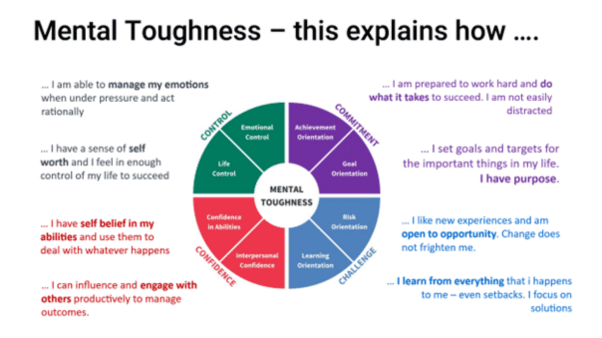
It is not too difficult to map each of the mental toughness factors to one or more core elements of Intrinsic Motivation.
In summary
Intrinsic Motivation is coming to the fore as an increasingly effective approach.
With understanding, careful thought and deliberate application, although more challenging than simpler forms of motivation, it has the capability to address the challenges of the 21st Century, and deliver much better outcomes.
Missed part one? Read it here.

Written by Doug Strycharczyk
Doug is the founder of AQR International in 1989 and co-developer of the 8-factor mental toughness concept and the MTQPLus measure. He is also co-developer of the RAMP measure used in organisations to assess motivation in their organisations. Doug is a people and organisational development expert. Working in more than eighty countries, he is recognised an authority on leadership and motivation, teamworking, coaching and organisational development especially in high stress environments. He is co-author of “Developing Mental Toughness”, a global best seller.