


‘‘Working hard for something we don’t care about is called stress; working hard for something we love is called passion.’’
– Simon Sinek
Part one: How motivation is changing as a result of the market and salesperson changing.
What do we mean by motivation and why are we interested in this in the world of sales?
There are many definitions of motivation, but here is a summary:
Motivation is the psychological force that explains why a person does something, particularly if it’s something that is challenging. It’s the driving force behind what you are doing or what you want to do.
Motivation is what helps you stick to a long sales process. It causes you to optimise your actions to get as close to your goals as possible and then exceed them.
It’s not too difficult to see why motivation has always been of core interest in the world of sales.
A motivated sales team will outperform a poorly motivated one and will enjoy better wellbeing. What’s more, there is motivation and there is motivation.
We can be motivated to do something that we have been asked to do and get satisfaction from doing it, however it might not demand any special effort from us.
The best individuals give what psychologists call their ‘discretionary effort’. This involves going over and above what is expected when we are especially well motivated. Interestingly, this can also be more rewarding and provide a sense of satisfaction.
It is also not about making people work harder but working smarter and making the best use of your qualities as well as gaining satisfaction and enjoyment from what you are doing. Achieving this can result in the salesperson being less stressed because they want to do the work.
“To be the best version of you that you can be” is the challenge for salespeople and supporting salespeople in this is the challenge for sales leaders.
However, motivation comes in many colours and has changed over time.
A brief history of motivation
I started work as a management Trainee in September 1969 (really!). The first thing my employer did was send me on a course on Management and Leadership at what is now Northumbria University. There, I learned all about Taylorism: the prevailing wisdom about managing and motivation for most of the 20th Century.
Called Scientific Management, it suggested that if you told someone clearly what was expected from them and it was challenging and realistic, then they would comply with that. Obedience was a byword at that time. We still have vestiges of that in the form of job descriptions and appraisals, and we know how useful they have (not) proved to be.
In the 1970s, we saw the emergence of reward systems. This could be piecework, commission, promotion, awards, prizes and even a negative form where you keep your job if you hit your target.
This is what is called Extrinsic Motivation: doing something because of factors external to you with a reward of some form, which is comparatively easy to apply.
For a small number of people, this had some impact but for the majority, it tended to be limited.
Then, curious why the Japanese organisations were suddenly so successful, we started to engage people in team working and in developing and improving what they do: quality circles and improvement teams emerged.
Employees warmed to these and certainly employee engagement remains high on the leadership agenda today.
This was driven by several factors:
- Better education: employees could now pick and choose jobs.
- Better employment opportunities for most people
- Raised aspirations
- Increased awareness of wellbeing
As a result, new challenges emerged for sales leaders:
- Selection and talent management
- Retention of the best people
- Optimising and raising performance
- Agility: learning to live with change especially new technologies.
Then came an understating that Intrinsic Motivation, a long way from Taylorism, might be the answer to the 21st century challenge.
Could we motivate salespeople to like what they do so much, that they will stay and enjoy good wellbeing, and at the same time, avoid burnout and stress.
To this day, the range of options for motivation can be neatly summarised in this image of the Self-Determination continuum:
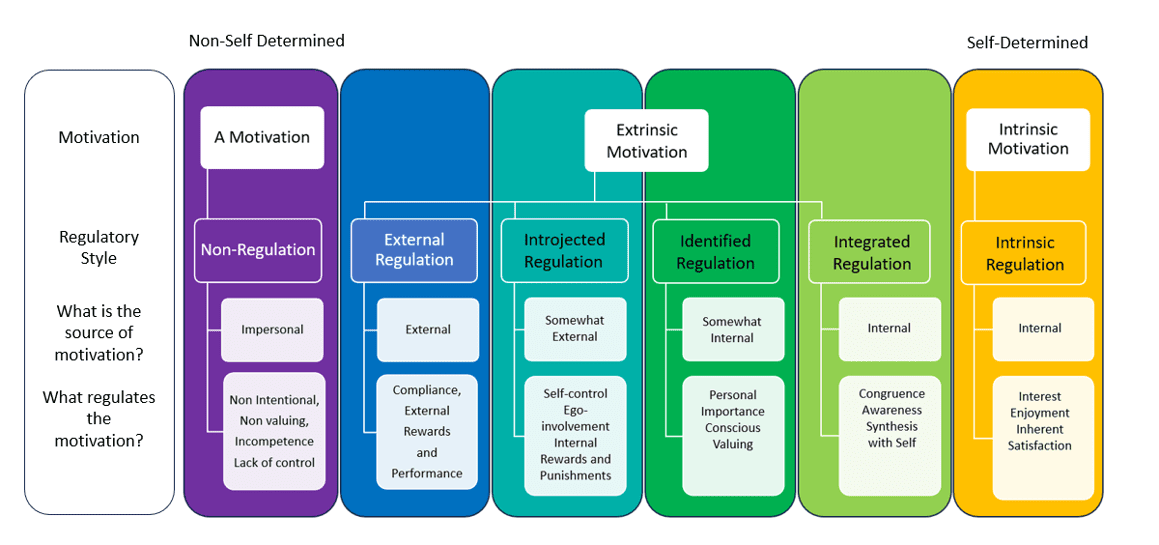
Intrinsic motivation is completing an activity for its inherent satisfaction rather than for a consequence or reward. In other words, doing something because it’s what you want to do, you like doing it, and you get a buzz out of it.
It’s not such a big stretch; think about the new recruit. Most arrive “pumped up” and excited about the opportunity that they have been given. They are arriving with elements of Intrinsic Motivation or, at least, expectations that they will find it in the opportunity.
In summary
The world is changing and the way salespeople can be motivated to succeed in a changing high-performance world is changing.
Intrinsic Motivation is coming to the fore as an approach that is increasingly effective with 21st Century sales teams.
It matters for sales leaders too.
So what should we be doing?
Sales leaders should be asking themselves:
- What motivates my salespeople and the sales team?
- What kind of a role model am I: what is my motivation?
- How can I tailor our approach to the changing world? Consider: people’s expectations, the impact of technology, and the way clients see sales
Salespeople should ask themselves:
- What is my own motivation and is it being supported here? What “button do I need to press”?
- What can I do to build my motivation?
- How does my team help or hinder what I am doing and what can I do about that?
In part two we take a deeper dive into Intrinsic Motivation to help you answer these important reflective questions. The more you understand the more effective you can be.

Written by Doug Strycharczyk
Doug is the founder of AQR International in 1989 and co-developer of the 8-factor mental toughness concept and the MTQPLus measure. He is also co-developer of the RAMP measure used in organisations to assess motivation in their organisations. Doug is a people and organisational development expert. Working in more than eighty countries, he is recognised an authority on leadership and motivation, teamworking, coaching and organisational development especially in high stress environments. He is co-author of “Developing Mental Toughness”, a global best seller.