



Negotiation and closing are two fundamental elements of business-to-business (B2B) sales, and the close naturally follows a successful negotiation.
I have been working in and around B2B sales since the early 1980s and, despite what many people will tell you, negotiating techniques have not changed all that much in the past forty plus years. The client asks for a discount, and the seller usually obliges.
In 2015, a company Sales Director asked me to meet with him. His primary concern was that his salespeople were poor negotiators and, to use his words, ’They are giving away my profit.’
After an initial fact-find meeting, I presented my training solution and the associated costs. He studied the total investment required and said, ‘That’s more than I thought. Can you do anything on price?’
I gave him an ironic smile; he was doing to me exactly what his customers were doing to his salespeople.
‘John’ I said, ‘on the basis that you are asking me to teach your people how not to give discounts, I’m sure you won’t take offence if I refuse to give you one.’
He laughed and admitted he had simply asked out of habit. The deal was signed at my full asking price.
The discounting problem
Most organisations follow a hierarchical approach to discounting.
Junior salespeople are given a strict limit on the discount they can offer. The exact figures vary from business to business, but for simplicity, let us assume a maximum of 15%. If the client demands more, the salesperson refers the request to a sales manager, who may authorise up to 25%. If the client wants even more, the matter is escalated to the Sales Director, who might offer up to 40% in exceptional circumstances.
This model has three major flaws:
1. Junior salespeople default to the maximum
When asked for a discount, many immediately offer 15%, forgetting there are fourteen other numbers before it.
2. Customers learn to escalate
Once a customer realises the sales manager can offer more than the junior salesperson, they will ask to be referred upwards.
3. Escalation becomes the norm
Once customers discover the Sales Director holds the largest discount authority, they will always seek access to that level.
A radical alternative
My solution to this is, at first glance, quite radical. I advise clients to allow their most junior salespeople to offer the same maximum discount as their Sales Director.
After the initial disbelief subsides, I explain why:
Modern buyers want to deal with a single point of accountability, not someone who constantly needs to refer decisions to a manager. When you give people greater authority, you also give them greater responsibility.
Interestingly, junior salespeople with the ability to offer discounts of up to 40% rarely do so. In fact, clients who adopt this model often find their junior staff give far fewer discounts overall, let alone the 15% they previously offered as a matter of routine.
I was explaining this concept to a large corporate client during a sales management workshop attended by both the Sales Director and several sales managers. One manager commented:
‘That idea sounds great in principle, but it wouldn’t work in my team; I have a few idiots who would offer stupid discounts.’
I immediately turned to the Sales Director and asked: ‘Why are you allowing him to employ idiots?’
He simply shrugged and said: ‘Good point.
The hidden cost of discounting
There is, however, a deeper issue: any discount, no matter how small, erodes profit.
Consider this example:
If a business produces or purchases an item for £50, that is its cost price. If it sells the product for £100, that represents a 100% mark-up and a potential gross profit of £50.
If a salesperson offers a 10% discount, the selling price falls by £10. However, that £10 reduction comes directly from the £50 margin, meaning profit drops by 20%.
In other words, one-fifth of your gross profit disappears with just a 10% discount.
Understanding the deal zone
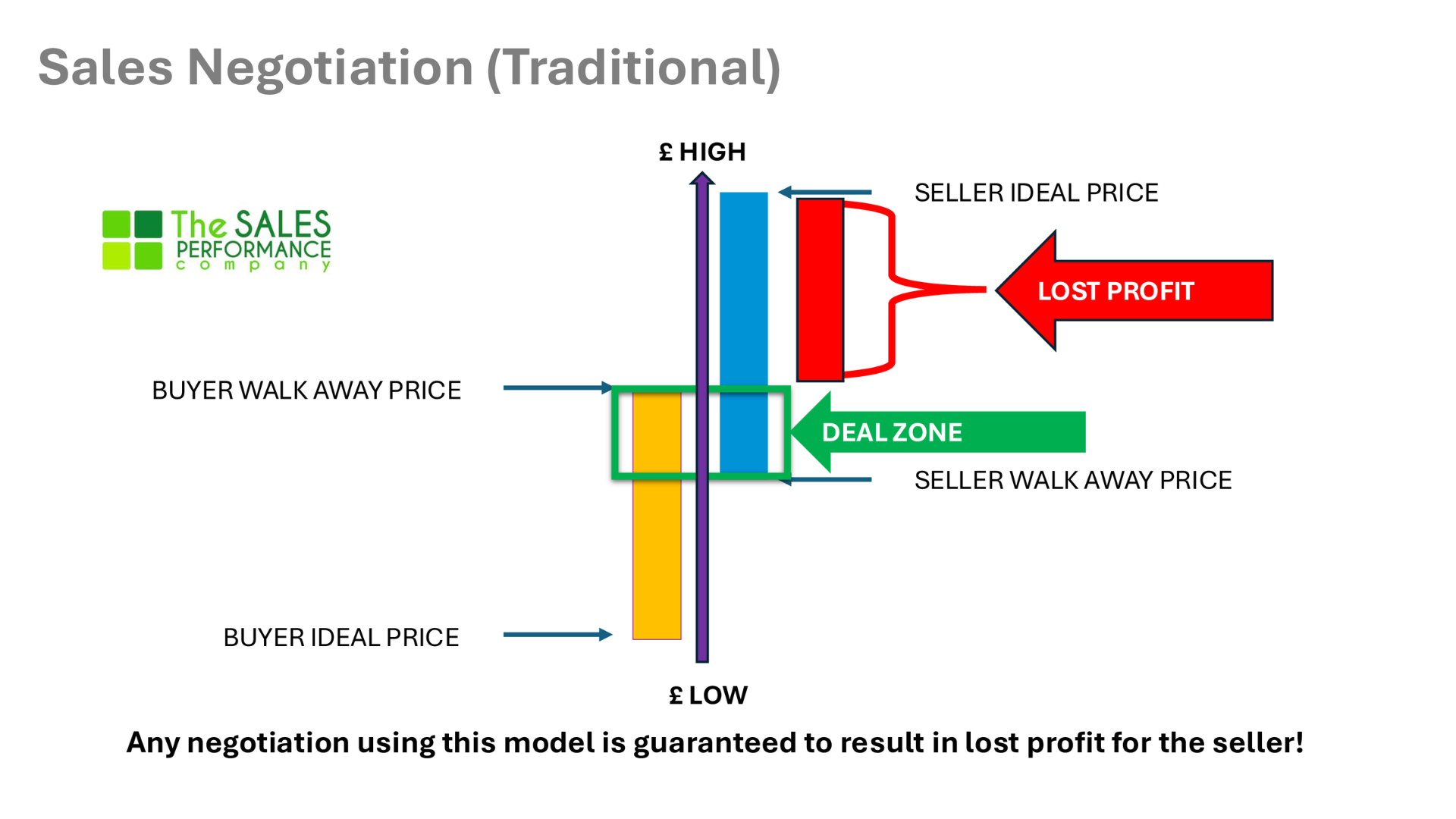
In every negotiation, both parties have boundaries.
The buyer has:
- A maximum price they are willing to pay (their walk-away price)
- An ideal purchase price
The seller has:
- A minimum acceptable price (their walk-away price)
- An ideal selling price
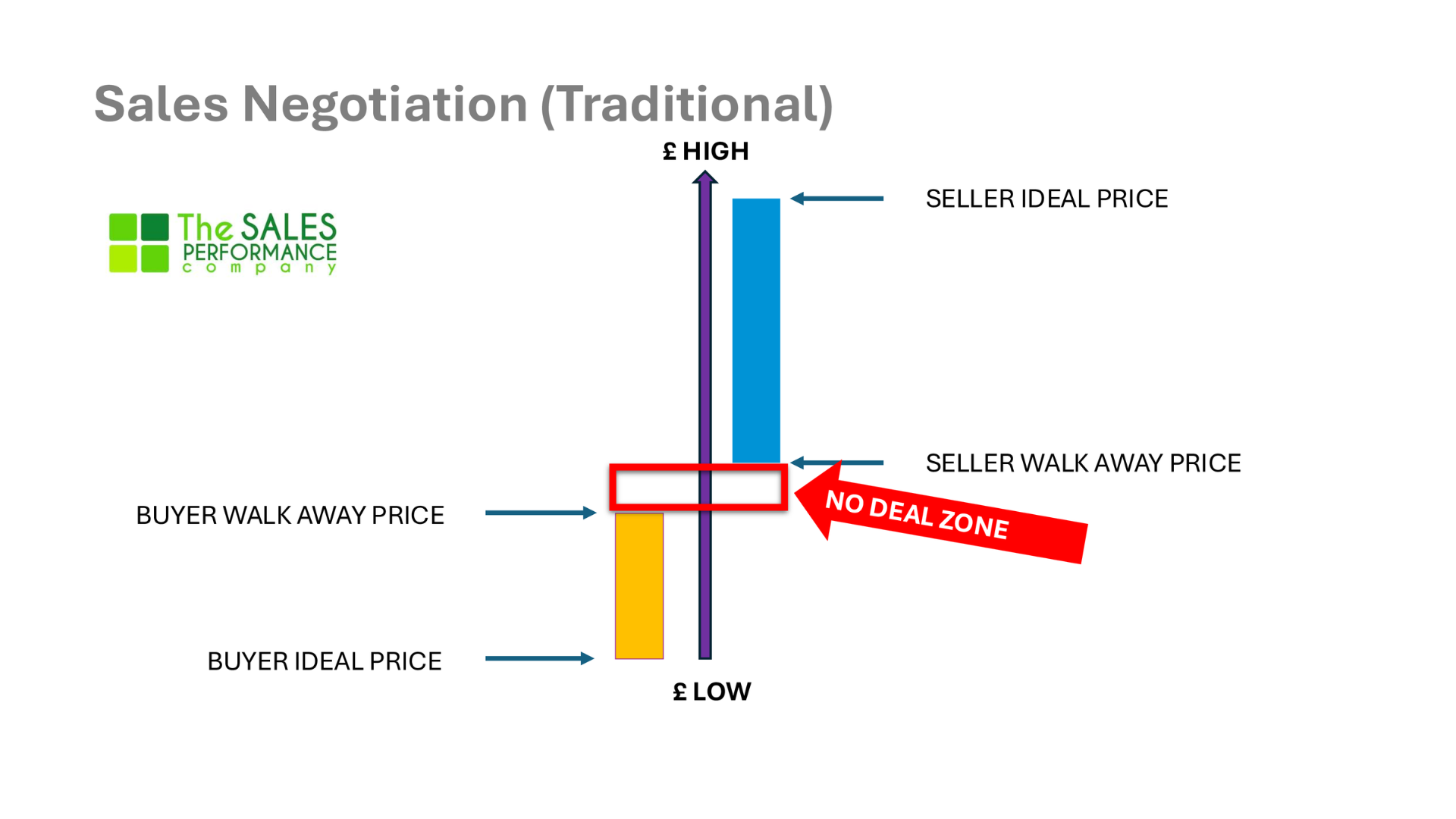
Where the buyer’s maximum overlaps with the seller’s minimum, a Deal Zone is created.
Unfortunately, many sales fail because there is no overlap; the walk-away prices are simply too far apart.
Avoiding common sales negotiation pitfalls
So how do we negotiate more effectively?
Establish the budget early
During the fact-find stage, the seller must gain a clear understanding of the buyer’s available budget. Equally, buyers should have a realistic sense of likely costs.
Trade, don’t discount
Price reductions should only happen in exchange for something valuable in return, perhaps a larger order, upfront payment, or a longer contract.
Reduce scope, not value
If a buyer insists they cannot afford your solution, remove elements from the proposal. Make it clear that a lower price means a lower specification.
Sell the whole, not the parts
Experienced buyers often negotiate line by line. Your task is to demonstrate the value of the complete solution.
Aim for perceived fairness
A true win-win negotiation is not purely financial; it is one where both parties feel the overall value is fair.
Final thought
Entire books have been written on sales negotiation, and this short article only scratches the surface of a complex subject. Hopefully, you have found one or two ideas here that are both practical and perhaps a little different from the usual advice.
I will leave you with one final thought.
In my experience, the greatest sales negotiation win rarely happens at the negotiating table. If you offer a premium product or service, the real negotiation advantage begins at ‘Hello’.
ISP members can catch up with the webinar on this topic here.

Written by Stuart Allen F.ISP FCMI, Founder and Managing Director of The Sales Performance Company Limited
Stuart Allen F.ISP FCMI is Founder and Managing Director of The Sales Performance Company Limited. A company that was formed in 2011 to provide B2B sales training, sales performance coaching, sales strategy and consultancy services. Prior to setting up this business Stuart had a highly successful 30-year career in sales and sales management.