


Client retention is often seen as the safe, predictable part of a sales team’s revenue plan. But, as we revealed in our recent ISP webinar, that assumption is exactly what makes retention risky. This article offers actionable strategies and tools to help sales teams protect revenue, differentiate value, and win must-keep accounts.
Why client retention matters now
Retention efforts are supposed to be straightforward: you know the client, you’ve delivered the work, and you’re the incumbent. But this sense of security is deceptive.
The real danger is “incumbentitis”: the tendency to skip strategic conversations, reuse old messaging, and assume delivery speaks for itself. It weakens positioning, quietly handing competitors time, access, and narrative control.
Most client losses don’t happen during a formal procurement process; they can be traced back months or years earlier, when commercial focus drifted and retention stopped being actively managed.
Spotting the risk: Early warning signs
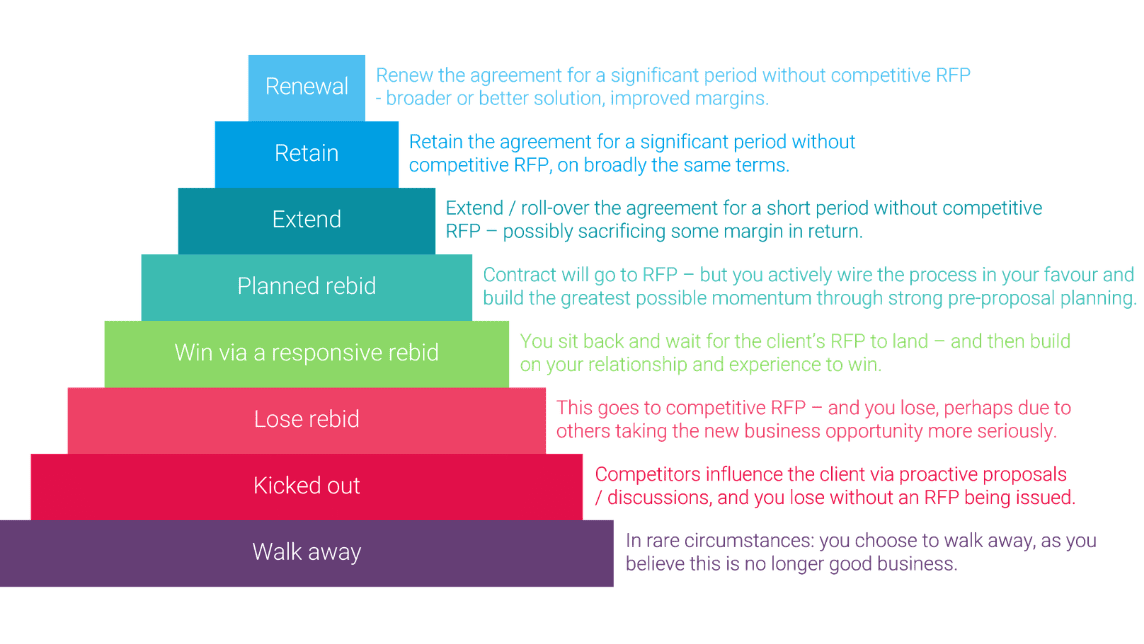
The pyramid of client retention doom shows how even strong incumbents can slide from renewal on better terms to losing the account altogether. Each step down the pyramid represents lost leverage, and fewer options to recover it.
Key warning signs include:
- Reduced access and engagement (e.g., fewer check-ins, postponed Quarterly Business Reviews)
- New stakeholders appearing unexpectedly
- Requests for performance summaries or competitive due diligence
- Renewal delays and disengagement (“just send what you usually send”)
- The involvement of third-party consultants
Recognising these signals early allows teams to course-correct before competitors exploit the drift.
Strategic repositioning: Responding not reacting
Our webinar highlighted that only 38% of organisations have a defined process for client retention.
Key steps include:
- Assembling the right internal team early
- Focusing on winnable accounts with true strategic advantage
- Building targeted engagement campaigns
- Strengthening relationships with client champions and stakeholders
- Developing a compelling, future-focused value proposition
- Creating a clear project plan aligned to retention timelines
- Conducting thorough risk assessments and sourcing high-quality content for proposals
When time is short, a minimum viable position checklist can help sales teams focus on the essentials.
Messaging that scores: reframing value
Client evaluators and decision-makers are scoring confidence in future delivery rather than nostalgia for past success. The strongest retention campaigns shift messaging from “what we did” to “what’s next.” Examples include:
- Instead of: “we delivered Phase 1 ahead of schedule,” say: “early delivery of Phase 1 means Phase 2 can now accelerate by three months; here’s our proposal.”
- Instead of: “we’ve had a great relationship,” highlight how you’ve evolved with the client’s changing needs.
A useful framework is to articulate value on three levels:
- Stakeholder value: Day-to-day impact for users and champions
- Organisational value: Alignment with strategic or mission-level goals
- Perceived value: How compelling and differentiated your offer feels
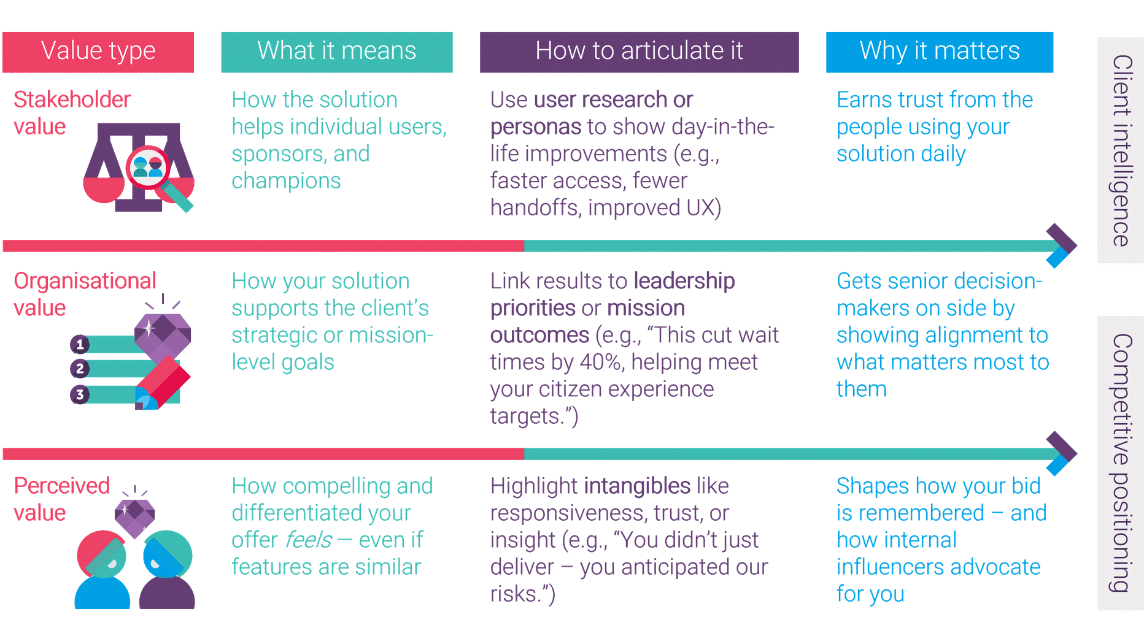
Together, these layers shape how confidently client stakeholders can advocate for you behind closed doors.
The retention campaign: Beyond the proposal
Winning retention is a year-round campaign, not a single moment. Sales teams that rely on formal Request for Proposal (RFP) responses alone, operate at a disadvantage.
Use strategic deliverables such as executive brochures and value reports to reframe performance and preview future direction. Multimedia, journey maps, and prototypes can also help clients visualise the future with you as their partner. These artefacts reduce decision risk for the client by making continuity, innovation, and future value tangible, before competitors enter the fray.
Post-award, the next retention campaign starts immediately. Tools like win reviews, new value reports, and proactive “birthday proposals” keep your team visible and relevant.
Team alignment: Turning collaboration into competitive advantage
Internal alignment is critical. The message house model enables every function (sales, delivery, proposals, leadership) to tell a unified story.
Practices such as “one voice” briefings, strategic reviewers, and rehearsal of informal touchpoints embed alignment into daily operations.
Conclusion
Successful sales teams treat client retention as a deliberate commercial discipline. By spotting risks early, planning strategically, reframing value, aligning teams, and using the right tools, you can protect revenue, differentiate value, and win must-keep accounts.
If you’re an ISP member, you can rewatch this webinar: ‘The client retention playbook: Proven moves to protect revenue’ here.
Not yet a member? Join as an Affiliate to watch three webinars for free!
Written by Lorraine Baird and Ceri Mescall

Lorraine Baird FF.ISP, Director, Strategic Proposals Ltd, is a trusted bid and proposal specialist with over 20 years’ experience helping organisations win the right business – smartly and cost-effectively. As a Director at Strategic Proposals, she’s known for her sharp strategic thinking, calm leadership under pressure, and an uncanny ability to turn even the vaguest brief into a winning strategy. She’s helped secure contracts worth billions, including a £500m financial services win and a £1bn infrastructure deal that tripled projected revenue.

Ceri Mescall, Managing Director, Strategic Proposals Canada, is a leading pursuit professional who brings a customer-first lens, and a challenger mindset, to high-value deals. With 15+ years securing billions of dollars in revenue, she combines executive-level strategy with thought leadership that elevates how sales teams position value, protect renewals, and outpace competitors.