


Turning sales from art into measurable science
For years, sales performance has been viewed as an art, driven by personality, intuition, and experience. But today, the data tells a different story. Insights from over 1,000 Sales Capability Assessments (SCAs) conducted through the Institute of Sales Professionals (ISP) reveal that true sales mastery comes from measurable capability: the ability to think commercially, act strategically, and lead ethically.
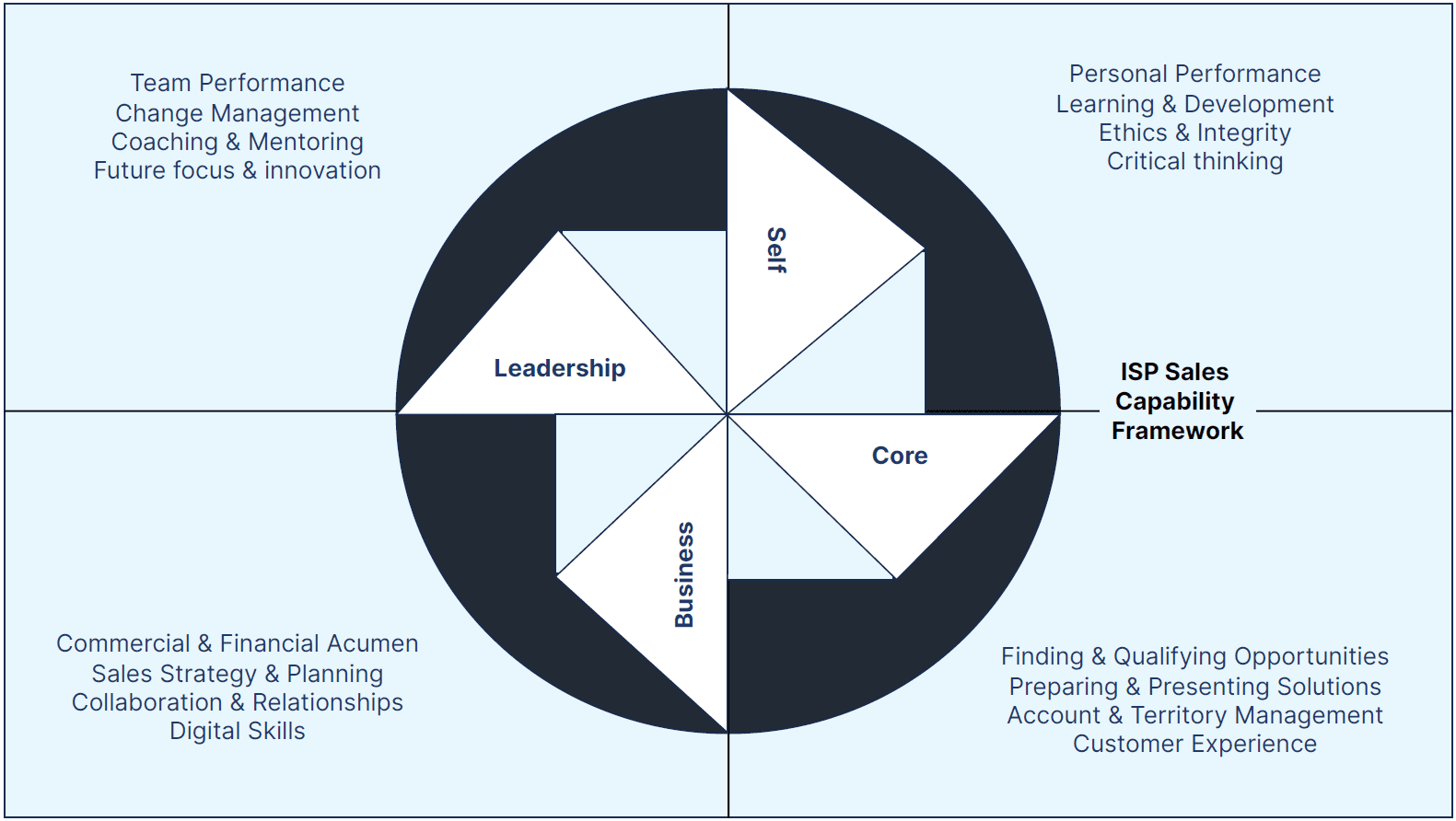
The ISP Sales Capability Framework defines the essential knowledge, skills, and behaviours required for effective and ethical sales performance. It’s not about charisma, it’s about competence. The SCA, a data-driven diagnostic aligned with this framework, measures exactly what salespeople know and how effectively they apply it across real-world scenarios. From opportunity qualification to commercial negotiation, it provides an objective view of the capabilities that actually drive revenue.
Discover the ISP Sales Capability Framework here.
The Sales Capability Assessment and whole career support
Based on the ISP Sales Capability Framework, the Sales Capability Assessment (SCA) is a structured, data-driven evaluation designed to measure what an individual salesperson actually knows about selling across the full spectrum of sales knowledge, commercial understanding, and applied judgment.
The SCA covers key domains such as lead qualification, stakeholder management, value-based selling, pipeline control, forecasting accuracy, commercial negotiation, and strategic account planning. Questions are scenario-based and test real-world understanding, not just theoretical knowledge or memorised terminology.
It covers four levels of professional growth from early career salesperson to sales director / VP Sales and at each level, different aspects of the capabilities in each quadrant are assessed.
The SCA produces a detailed report rating each area, signposting where to focus development time, where Self-Directed Learning is most appropriate, and helps assess readiness for career progression. It is taken twice (normally 12 months apart) in order to measure improvements over time.
Insights
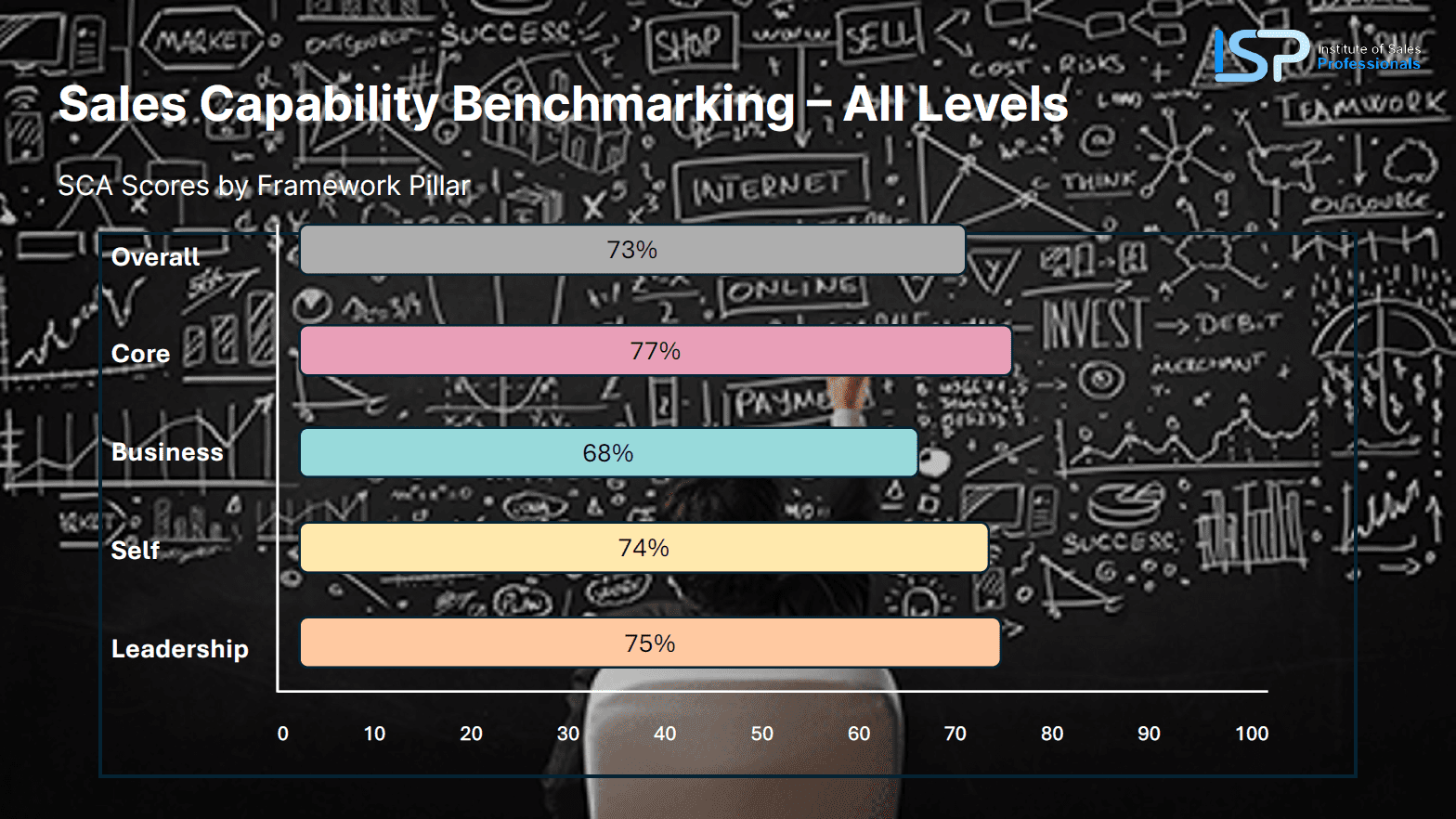
Insights from the SCAs reveal that true sales mastery comes from measurable capability: the ability to think commercially, act strategically, and lead ethically. Across industries and sales levels, one theme stands out: “Business” acumen is the weakest and most critical area of opportunity.
The commercial gap: Why business acumen matters
When salespeople lack business fluency, they struggle to connect solutions to client strategy. Instead of speaking the language of CEOs and procurement teams (return on investment, risk reduction, and growth enablement), they default to product features and price. The result? Missed value, margin erosion, and stalled deals.
The data is stark:
- Across all SCA levels, the Business quadrant scores 8–10 points lower on average than Core and Leadership competencies.
- Over 60% of professionals admit they struggle to “understand how clients make money.”
- External research from Gartner and LinkedIn (2025) confirms this pattern: buyers now expect salespeople to act as strategic partners, not transactional vendors.
To sell effectively in 2025 and beyond, salespeople must think like consultants and communicate like CFOs.
Defining business acumen in modern sales
Commercial fluency isn’t about memorising financial terms, it’s about interpreting how your customer’s business works and positioning your solution as a lever for measurable performance.
The most successful sales professionals master five core competencies:
- Financial Literacy – Understanding profit, loss, cost drivers, and ROI.
- Strategic Awareness – Reading market forces and competitive positioning.
- Customer Value Alignment – Linking propositions to outcomes like growth, efficiency, or risk mitigation.
- Commercial Negotiation – Protecting margin while creating shared value.
- Economic Judgment – Balancing pricing, investment, and risk trade-offs.
These are the capabilities that transform sales conversations from tactical to transformative, and they are increasingly the difference between good and great.
Leadership lessons: Beyond the “accidental manager”
Another pattern emerging from SCA data is the prevalence of the “accidental manager”. These are high-performing salespeople promoted to leadership roles without the management or coaching skills required to succeed. Leadership is a distinct discipline; it demands change management, resilience, and ethical influence. We also need to remember that “leadership” is key throughout a sales professional’s career. At the early stages, it’s about leading a sale, pulling together cross functional inputs to meet a clients’ requirements. For senior sales professionals, this migrates to managing teams and/or addressing more complex client relationships.
The ISP’s Sales Behavioural Assessment and Learning Management System (LMS) now help organisations close this leadership gap, ensuring managers can build, coach, and sustain high-performance teams rather than simply sell through them.
The path forward: Measurable growth, real impact
The SCA is more than an assessment, it’s a roadmap. By benchmarking capability and measuring progress over time, it empowers individuals to own their development and gives leaders data-driven clarity on where skills building will be most beneficial (to both the individual and the organisation).
For businesses, this means:
- Greater confidence in talent decisions
- Stronger mentoring / coaching conversations grounded in data
- A culture of continuous learning tied to measurable improvement
In short, it transforms sales capability from an assumption into an asset.
Bottom line
Sales success in 2025 demands more than persuasion, it requires precision. Those who master the language of business will not only sell more; they will lead more effectively, influence with integrity, and earn lasting trust from their clients.
Register here for Les’ webinar on 24/11/25, which will focus on the ISP sales capability framework and insights from the sales capability assessment.

Written by Leslie R. Hines
Les is a dynamic force in the professionalisation of sales, an advocate for elevating the discipline to stand proudly alongside law, engineering, and marketing. With a relentless drive to reshape how sales is perceived and practiced, Les works to establish it as a trusted, respected, and indispensable function within any organisation. Across a distinguished global career, Les has mastered the art of transformation, of businesses, markets, and mindsets. He brings sharp strategic thinking and real-world execution. His expertise in revenue growth, market development, and product innovation has helped companies redefine their value in competitive landscapes. But Les is more than a strategist, he’s a builder of ideas, a challenger of norms, and a creator with taste. He thrives on clarity, momentum, and meaning. Whether driving complex global initiatives or unlocking fresh growth paths, Les brings a blend of intellectual depth and human intuition to everything he does. His systems-oriented mindset is always paired with a deep understanding of what feels authentic and what truly resonates. Les works to redefine what it means to lead with intelligence, creativity, and precision. In every conversation, boardroom, or brainstorm, Les is natural, incisive, and never afraid to ask the bold questions, the kind that move things forward. He’s not in it for the fluff, he’s here for impact. For ideas that are clean, bold, and purposeful and for work that connects.