


Ever since the term “marketing” was coined there’s been a debate over whether it should take precedence over sales.
This longstanding debate over whether sales or marketing should be more central to a business strategy is crucial for understanding how businesses can grow and thrive.
Each function plays a distinct role in generating revenue and building long-term relationships with customers, but the question remains: which one should take precedence?
In this two-part series, we will compare the Mackenzie-Bauer Framework of Sales Leadership with Kotler’s Expanded Marketing Process to explore this issue in depth and determine which approach provides the most value.
Both models offer valuable perspectives, and by analysing them side by side, we can better understand their respective strengths and limitations.
Introducing the Mackenzie-Bauer Framework of Sales Leadership
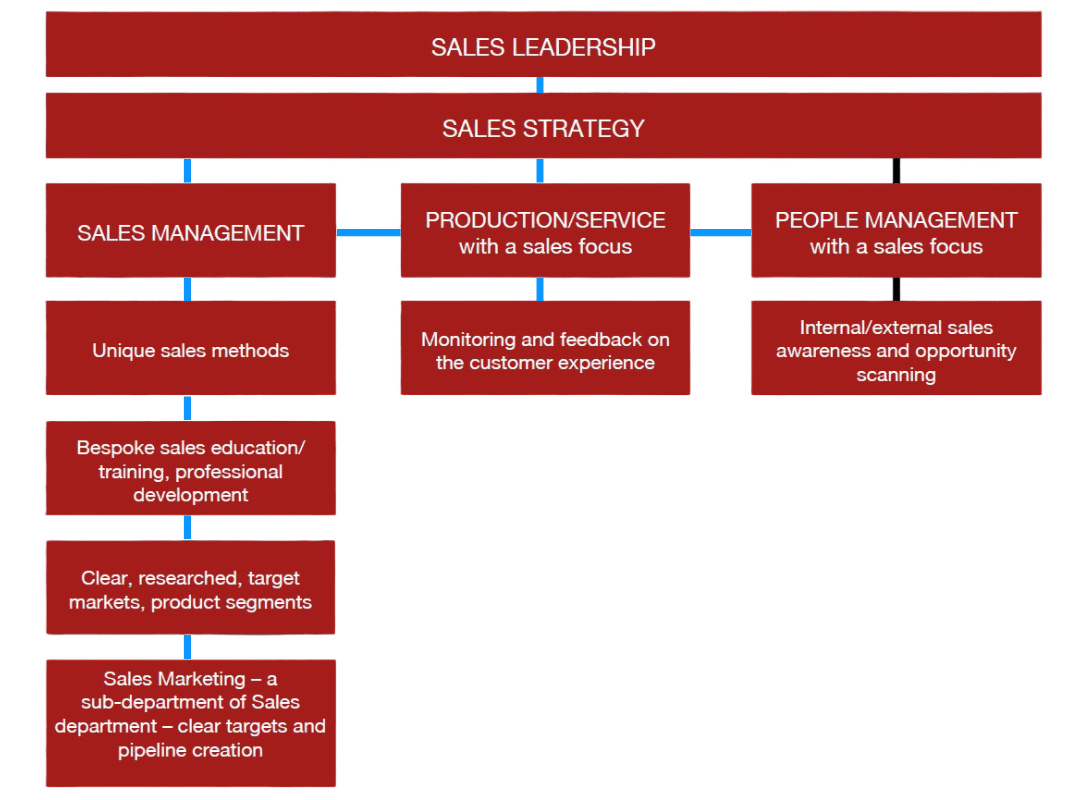
Figure 1 illustrates the framework of a sales-focused business. This differs from the traditional sales funnel: whilst the marketing department still helps with the generation of business, it is controlled by the department that must bring in the income, the sales department.
The Mackenzie-Bauer Sales Leadership Framework reflects the point that the antecedent of any effective sales strategy is sales leadership. For clarity, a sales leader is someone who leads a business or organisation and puts the customer/client foremost. They focus on providing everyone with the tools, motivation and development structure required to be a world-class organisation.
Crevens et al (2012) defines sales leadership as “extending beyond traditional management by requiring leaders to apply strategic insights to align sales operations with broader business goals”. However, we consider that business survival depends on sales and the above definition does not focus on ethical selling or the need for sales to achieve other business goals. We therefore define sales leadership as “the process of leading an organisation that puts ethical selling at its core, ensuring all aspects of the company are aligned with the sales mission”.
This conceptual framework has been designed to allow for bespoke adaptation, thereby showing a route for businesses or organisations to create their own unique selling proposition (USP).
Figure 1: The Mackenzie-Bauer Sales Leadership Framework
Where does marketing fit in?
The thrust of this argument is that sales may be the end of the “sales funnel”, but the sales strategy should be formulated first and should be the most important part of any business plan. Once the sales strategy is in place, then the marketing priorities should be the servant of the sales department and be constantly shifting to underpin all sales activities.
A business plan that shows a direct link to the overarching sales strategy is more constructive than a marketing plan that shows no connection to sales. Each department needs to work together for maximum effectiveness (Hult, et al, 2017).
It is often said that awareness is important; it is, however, awareness without sales is just that. There are many brands that we all know no longer exist; they did not suffer from lack of awareness but a lack of sales. Sales failure can be attributed to lack of agility, broken trust, products and a focus that does not position the sales connection to the customer as paramount (Friend et al, 2014).
The Mackenzie-Bauer Framework of Sales Leadership
In the Mackenzie-Bauer Framework, sales leadership is at the forefront of the entire business strategy. The model argues that sales strategy should guide all aspects of the business, from production and customer service to internal management and marketing (Figure 1). This framework places marketing as a subdepartment of the sales department, focusing on supporting sales efforts through targeted lead generation and pipeline creation.
Key features of this way of thinking include:
- Sales leadership: Sales leaders are responsible for providing direction, motivation and resources to the entire organisation.
- Sales strategy: Sales goals and strategies are the central focus of the business, with marketing and production supporting these efforts.
- Sales-driven management: All departments are aligned with the goal of supporting sales, and the entire business value chain revolves around driving revenue through effective sales practices.
While the Mackenzie-Bauer Framework emphasises direct revenue generation, Kotler’s marketing model advocates a broader customer-centric approach, suggesting that businesses should focus first on understanding the customer, which then enables sales success.
Shortcomings and benefits
The Mackenzie-Bauer Framework has the advantage of being sales-driven and agile, allowing companies to respond quickly to market demands and capitalise on opportunities. However, it risks neglecting the broader benefits of brand building and customer relationship management, which are essential for long-term success (Blythe & Megicks, 2010). A framework offers flexibility in thinking and can be adjusted within each department; however, the focus is customer service, trust building (Mackenzie, 2021) and sustainable sales (Mackenzie, 2023).
The success of sales leadership is reliant on the ability of the sales leader and leadership team (Craven, 2012). It depends on achieving a balance between driving sales and sales ethics, so leadership attributes need to include a clear focus on ethical sales (Ahli., et al 2024). Leader-follower relationships in smaller or newly formed companies should be closer and it may be that this approach is easier to install in small-to-medium companies or start-ups. This framework supports the concept of distributed leadership (Spillane, 2006), which can build a collective and aligned vision with the active and effective involvement of employees (Canterino et al, 2020) and allow greater potential for organisational change and development (Stoll and Seashore Louis, 2007).
The Mackenzie-Bauer Framework is not a replacement for preferred effective leadership behaviours but is designed to act as a critical guide to thinking in terms of organisational set-up or reimagining. For this framework to succeed, the CEO and all the leaders within management need to align with the sales vision and approach, with tough ethical standards imposed and monitored to ensure that employees are empowered to support the sales focus but not at the expense of reputation.
Part two of this article will follow, with the focus being on Kotler’s Expanded Marketing Model, specifically, how it compares to the Mackenzie-Bauer Framework.
For more interesting reads, subscribe to IJoST.
IJoST is now owned by ISP, and is the dedicated journal for sales professionals, educators and leaders
Written by Dr Colin MacKenzie and Dr Alexander C Bauer

Dr Colin Mackenzie, MSc, FHEA is an Associate Professor of Applied Sciences at Wittenborg University of Applied Sciences, a specialist lecturer at Edinburgh Napier University, and is a member of the advisory board for the South East Asian Sales Competition (SEASAC), an Erasmus+ project. He has over 40 years’ sales experience and is a high-growth business consultant. He holds a Doctoral degree in Business Management, a Master of Science degree in Quality and Business Excellence, and is a Fellow of the Higher Education Authority.
Contact: colin.mackenzie@wittenborg.eu

Dr Alexander C Bauer is an Associate Professor of Applied Sciences at the Wittenborg University of Applied Sciences with locations in the Netherlands, Germany, and Austria. He has more than a decade of international sales and management experience. Before he joined academia in 2014, he worked as an International Sales Manager, leading global sales teams and daily negotiations with customers and suppliers on a global level with business partners in North and South America, Europe and Asia. He studied Business Management with a major in Marketing and Sales in Germany and Estonia and holds a PhD in International Business Management. Besides being a lecturer, he is also a Trainer for Presentation Skills, Rhetoric and Sales.
Contact: alexander.bauer@wittenborg.eu
References
Ahli, M, Hilmi, M F, & Abudaqa, A (2024) “Ethical sales behavior influencing trust, loyalty, green experience, and satisfaction in UAE public entrepreneur firms,” Aptisi Transactions on Technopreneurship (ATT), 6(2), 149-168.
Blythe, J, & Megicks, P (2010), Marketing planning: Strategy, environment, and context, Pearson Education. Canterino, F, Cirella, S, Piccoli, B, & Shani, A B (Rami) (2020), “Leadership and change mobilization: The mediating role of distributed leadership,” Journal of Business Research, 108, 42–51.
Eloka, A (2022) “Internal Customers: The Asset of the Humanistic Workplace,” In: Ogunyemi, K, Okoye, E, Ogunyemi, O (eds) Humanistic Perspectives in Hospitality and Tourism, Volume II. Humanism in Business Series. Palgrave Macmillan, Cham.
Friend, S B, Curasi, C F, Boles, J S, & Bellenger, D N (2014). “Why are you really losing sales opportunities? A buyers’ perspective on the determinants of key account sales failures,” Industrial Marketing Management, 43(7), 1124-1135.
Hult, G T M, Morgeson, F V, Morgan, N A, Mithas, S, & Fornell, C (2017) “Do managers know what their customers think and why?” Journal of the Academy of Marketing Science, 45(1), 37-54.
Kotler, P, & Armstrong, G (2018) Principles of marketing (17th ed.). Pearson Education.
Kotler, P, Keller, K L, Brady, M, Goodman, M, & Hansen, T (2019) Marketing management (4th European ed.). Pearson Education.
Laugesen, L, & Yuan, Y’, “What Factors Contributed to the Success of Apple’s iPhone?,” 2010 Ninth International Conference on Mobile Business and 2010 Ninth Global Mobility Roundtable (ICMB-GMR), Athens, Greece, 2010, pp. 91-99, doi: 10.1109/ICMB-GMR.2010.63.
Mackenzie, C (2021) “Introducing the Psychological contract into Sales Education,” International Journal of Sales Transformation, 7.3, 16-18.
Mackenzie, C (2023). Sustainable sales – a definition. International Journal of Sales Transformation, 9.1, 40–43.
Cravens, D W, Le Meunier-FitzHugh, K, & Piercy, N F (Eds.). (2012) The Oxford handbook of strategic sales and sales management. OUP Oxford.
Spillane, J P (2006), Distributed Leadership, Jossey-Bass, San Francisco, CA.
Stoll, L and Seashore Louis, K (2007), Professional Learning Communities, Open University Press, New York, NY.